


Work Packages
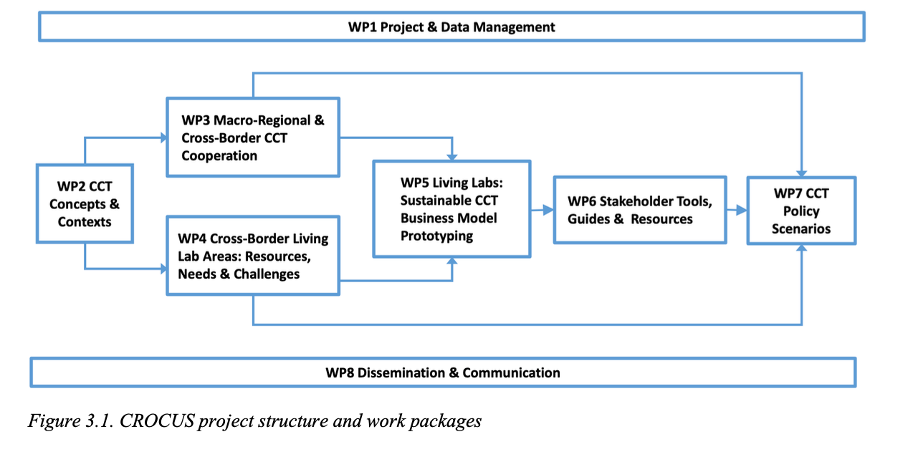
Work Package 1: Project and Data Management
Work Package 1 ensures the efficient coordination and management of the CROCUS project, overseeing administrative, financial, and operational activities. This work package provides the organisational framework to support collaboration among partners, monitor progress, and ensure the project adheres to its objectives and timeline. Work Package 1 also manages data collection, storage, and sharing processes, ensuring compliance with ethical standards and EU regulations on data protection. Regular reporting and communication mechanisms are established to maintain transparency and facilitate knowledge sharing among stakeholders. Aalborg University is leading Work Package 1.
Work Package 2: CCT Concepts and Contexts
Work Package 2 lays the theoretical and conceptual groundwork for the CROCUS project, drawing on interdisciplinary insights into cultural tourism and placemaking. It includes a comprehensive review of academic literature, policy reports, and findings from previous EU projects. This review identifies current trends, challenges, and opportunities for cultural tourism development in rural and remote areas. Additionally, Work Package 2 analyses existing cultural tourism business models, creating a typology based on heritage type, usage strategies, revenue streams, and sustainability considerations. The findings from this work culminate in the development of the project’s conceptual and methodological framework, which serves as the foundation for subsequent activities. ATLAS is leading Work Package 2.
Work Package 3: Macro-Regional and Cross-Border CCT Cooperation
Work package 3 examines cross-border cultural tourism cooperation in Europe’s macro-regions. It begins by mapping existing strategies and initiatives at EU, national, and regional levels to identify key trends, barriers, and opportunities. To gather insights, a series of Delphi studies engages experts from the four macro-regions, addressing critical policy challenges and identifying areas for future cooperation. The work package also includes in-depth case studies of eight cross-border initiatives, exploring governance structures, stakeholder engagement, and sustainability practices. The findings provide actionable insights for policymakers and stakeholders, forming a basis for future activities, including the living labs and policy scenarios. University of Oulu is leading Work Package 3.
Work Package 4: Cross-Border Living Lab Areas: Resources, Needs and Challenges
Work Package 4 establishes living labs in eight cross-border regions, initiating the empathising phase of the design thinking process. Each living lab consists of stakeholders from neighbouring border regions, coordinated by a local expert to ensure representation and relevance. The labs explore local challenges, collect data, and engage stakeholders to better understand the socio-economic, environmental, and institutional contexts of cultural tourism in the region. Surveys and interviews with citizens, businesses, and policymakers ensure diverse perspectives are included. This phase culminates in a comprehensive analysis of the living lab contexts, which informs the development of sustainable solutions in subsequent work packages. University of Pannonia and Zangandor Research Institute are leading Work Package 4.
Work Package 5: Living Labs: Sustainable CCT Business Model Prototyping
Work Package 5 focuses on developing sustainable cultural tourism business model prototypes through participatory design processes. Each living lab facilitates ideation workshops, engaging a wide range of stakeholders from both sides of the border. These workshops generate ideas and insights, which are then refined into two business model prototypes per lab. The prototypes summarise value propositions and sustainability considerations. Feedback workshops further refine the models, ensuring they align with local needs and are viable in the long term. Roadmaps for implementation, monitoring, and funding are developed to ensure the sustainability of these models beyond the project’s lifecycle. University of Maribor and Group NAO are leading Work Package 5.
Work Package 6: Stakeholder Tools, Guides and Resources
Work Package 6 synthesises the findings from previous work packages to create practical tools and resources for sustainable cultural tourism development in RRAs. These include a participatory toolkit for business model development, training materials, and good practice guides for policymakers and cultural institutions. An online navigation tool is also developed to provide tailored access to project insights and resources based on regional characteristics and stakeholder needs. The tools aim to empower communities across Europe to replicate successful practices and foster sustainable initiatives in cultural and creative tourism. University of Rijeka is leading Work Package 6.
Work Package 7: CCT Policy Scenarios
Work Package 7 develops forward-looking policy scenarios to enhance the role of cultural tourism in sustainable development. Based on evidence gathered across the project, the work package synthesises findings from Delphi studies, case studies, and living labs to produce actionable recommendations for each EU macro-region. These scenarios address key coordination challenges, align with EU policies such as the Green Deal, and explore strategies to balance socio-economic development between high- and low-tourism areas. Stakeholder workshops refine the scenarios, ensuring their relevance and feasibility. The final outputs will be presented at a high-level policy conference to support evidence-based decision-making. Aalborg University is leading Work Package 7.
Work Package 8: Dissemination and Communication
Work Package 8 ensures the effective dissemination of project findings and engagement with key audiences. This includes creating communication materials, organising events, and maintaining an active online presence. By sharing results with policymakers, stakeholders, and the public, Work Package 8 maximises the impact of the CROCUS project, ensuring its insights and resources reach those who can benefit from them most. It also supports ongoing dialogue to promote cultural and creative tourism as a driver of sustainable development and cross-border collaboration in rural and remote areas across Europe. University of Bergamo is leading Work Package 8.