


How can shared history, cultural heritage and local stories support sustainable tourism and strengthen the resilience of a cross-border region? These questions were at the heart of a public discussion organised during the Maupertuis 290 Symposium in Tornio.
by Lida Pyykkö, University of Oulu and EU CROCUS Project, and Jarkko Saarinen, Professor of Human Geography at the University of Oulu and Leader of the FRONT Research Programme.
On 5 September 2026, the Maupertuis Foundation organised a panel discussion entitled “Cultural Tourism in the Tornio Valley” as part of the Maupertuis 290 Symposium. The event brought together representatives from research, cultural heritage, tourism and regional development to explore how the Tornio Valley’s distinctive identity could become a stronger resource for its future.
The discussion was chaired by Professor Jarkko Saarinen, Professor of Human Geography at the University of Oulu. The panel included Titta Kallio-Seppä from the Museum of Tornio Valley, Juha-Pekka Koskinen from the Visit TornioHaparanda Association, Ulla Mikkanen from the National Land Survey of Finland and World Heritage Coordination, and Iida Pyykkö from the University of Oulu and the EU-funded CROCUS project. The Tornio Valley is characterised by a culture, language and history that extend across the border between Finland and Sweden. For local communities, the border does not simply represent a division between two countries. It is also part of a shared landscape shaped by mobility, family ties, cultural traditions and everyday cooperation.
This sense of “borderlessness” is one of the region’s most distinctive characteristics. It provides a strong foundation for developing cultural tourism experiences that connect places and communities rather than presenting them as isolated destinations.
The panel emphasised that cultural tourism should be rooted in the identities and experiences of local people. Living traditions, food culture, historical sites and stories associated with particular places can all help visitors understand the region more deeply. At the same time, their responsible use in tourism can strengthen residents’ sense of belonging and support the continuity of local knowledge.
The Maupertuis expedition: bringing scientific history into the present
One of the Tornio Valley’s most remarkable historical narratives is linked to the expedition led by the French mathematician Pierre Louis Moreau de Maupertuis in 1736–1737.
The multidisciplinary international expedition travelled to the Tornio Valley to carry out measurements under challenging Arctic conditions. Its findings demonstrated that the Earth is slightly flattened at the poles, supporting the model developed by Isaac Newton on the basis of his theory of gravity.
The expedition represents a milestone in the history of science. It also influenced European perceptions of the North and left a lasting mark on the places and communities of the Tornio Valley.
During the panel, participants considered how this scientific legacy could be interpreted for contemporary audiences. Historical expeditions are not simply events belonging to the past: their routes, measurement sites, landscapes and human stories can provide the basis for meaningful visitor experiences today.
Connecting scientific heritage with local culture and natural landscapes could therefore help the region develop a distinctive tourism narrative—one that combines European history, Arctic conditions, cross-border cooperation and a strong sense of place.
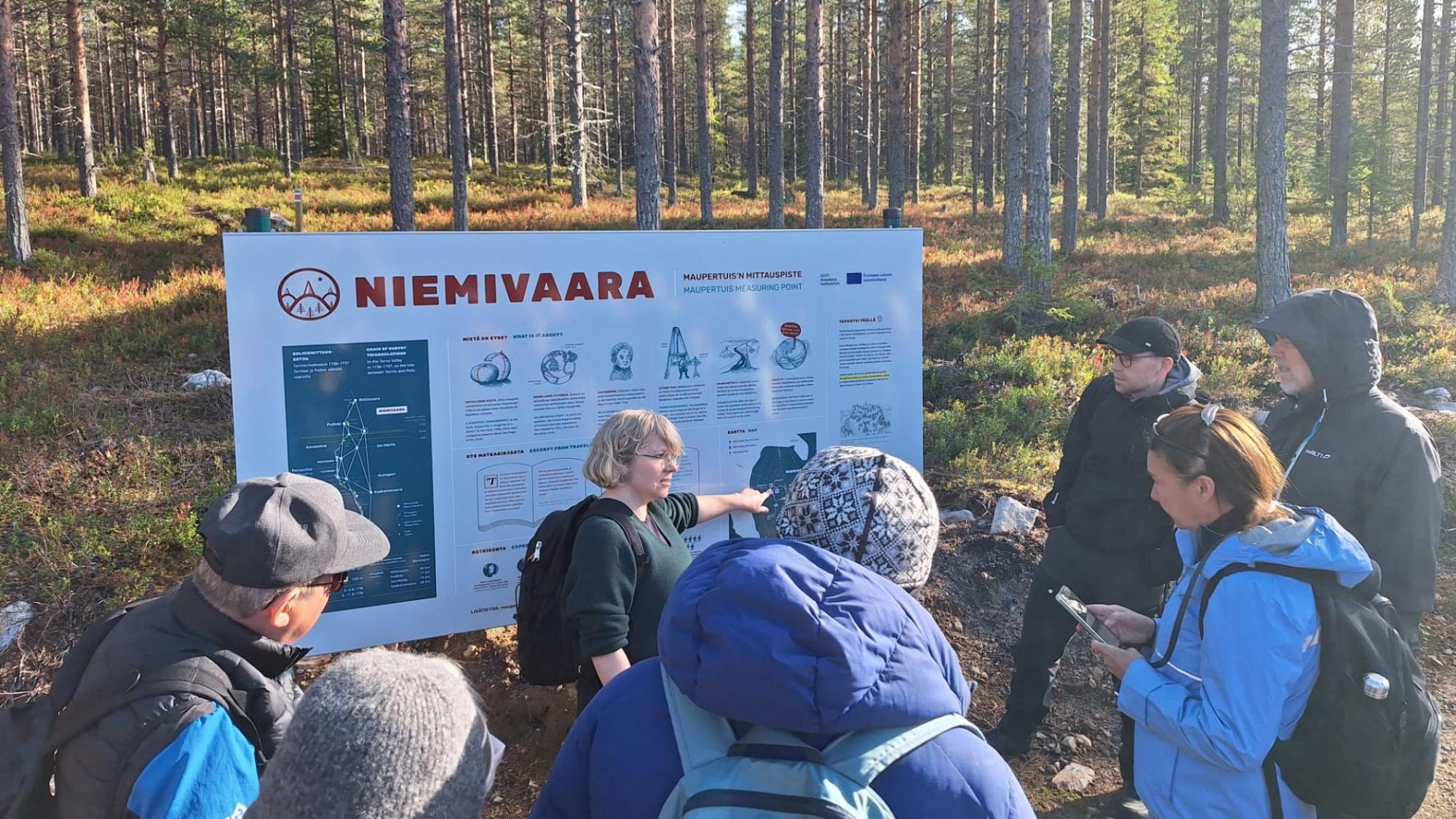
Participants visiting a site connected with the history and cultural landscape of the Tornio Valley.
Cultural assets with untapped potential
The discussion also reflected findings from the EU-funded CROCUS project, developed within the FRONT research programme.
The project’s research indicates that residents, tourism entrepreneurs and visitors recognise the value of the Tornio Valley’s cultural and historical sites. However, they also identify the need for further investment in their maintenance, accessibility, interpretation and overall visitor experience.
This reveals an important gap between the existence of valuable cultural assets and their effective use in sustainable tourism. Sites may be historically significant, but their potential remains limited if they are difficult to access, poorly maintained or insufficiently connected to other services and attractions.
The panel therefore highlighted the importance of moving from isolated cultural sites towards coherent experiences. This requires cooperation among municipalities, museums, tourism businesses, researchers, local communities and organisations operating on both sides of the border.
Greater financial resources are needed, but funding alone is not enough. Human expertise, storytelling skills, cross-border coordination, targeted marketing and thoughtful product development are equally essential.
The Tornio Valley already attracts visitors through activities such as cross-border shopping. Nevertheless, only a relatively small proportion of these visitors currently use local accommodation, restaurants or cultural services.
The challenge is therefore not only to attract more people, but also to encourage existing visitors to spend more time in the region and engage more deeply with its identity.
The panel proposed practical ways of linking cultural themes with the region’s established tourism strengths. Local food traditions, for example, could become part of broader cultural itineraries and cross-border experiences. Hotels could introduce rooms inspired by local historical themes, encouraging guests to discover nearby heritage sites.
One example is the Maupertuis Cabinet in Pello, located in a restaurant close to a site connected with the history of the Struve Geodetic Arc measurements. Initiatives of this kind demonstrate how historical narratives can be integrated into contemporary tourism services in accessible and creative ways.
Rather than treating culture as an additional attraction, cultural heritage can become the thread connecting accommodation, gastronomy, landscapes, museums, events and local communities.
Cultural tourism as a source of regional resilience
The panel discussion demonstrated that local identity is not only a tourism asset. It can also contribute to regional resilience.
When communities recognise the value of their heritage and participate in shaping how it is presented, tourism can reinforce local pride, support cooperation and create new opportunities for businesses and cultural organisations. It can also help remote and border regions differentiate themselves through qualities that cannot be replicated elsewhere.
For the Tornio Valley, these qualities include its shared cross-border culture, multilingual heritage, Arctic environment and exceptional place in the history of European scientific exploration.
Developing this potential requires a long-term approach. Cultural tourism must respect local meanings, benefit communities and contribute to the preservation of the places and traditions on which it depends. It should also create connections between sectors and across borders, transforming fragmented resources into a shared regional story.
The Maupertuis 290 Symposium offered an important space for this dialogue. It confirmed that the Tornio Valley already possesses the cultural foundations for distinctive and sustainable tourism development. The next step is to strengthen cooperation and translate these foundations into high-quality experiences that are meaningful for visitors and valuable for local communities.